

Wednesday, July 3, 2019


Wednesday, June 26, 2019
And now, a word about grit.
In last week's blog I wrote about the importance
that self-confidence plays in success, and offered up the advice to "fake
it" if necessary, since perception is reality.
But equally important is the ability to recover
from failure and try again. Sadly, one
of the side effects of helicopter parenting and grade inflation is that people
don't learn how to fail. If they did,
they would realize that it isn't the end of the world.
We are hard wired to dislike failing more than we
like winning. This makes us naturally
risk adverse. But, if you don't keep
trying you won't ever succeed. Research
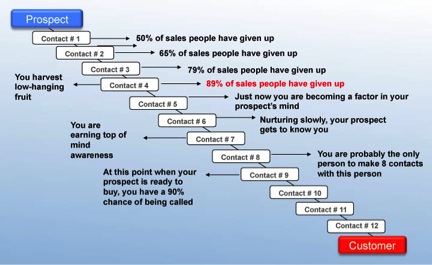
shows that it takes eight touches to make a sale, yet most people stop at
two. Here's a nifty graphic from
Microsoft...
But it's also important to learn from your failures,
since as Einstein pointed out (unless it's misattributed)," the definition
of insanity is doing the same thing over and over again, but expecting
different results."
That's probably why after he was rejected twice
from USC, Steven Spielberg didn't give up on going to college, but instead decided
to go to Cal State. Pivoting seems to
have worked out ok for him. ;-)
Beasley, L. (2013, October 10) Why It Takes 7 - 13+ Touches to Deliver a
Qualified Sales Lead. onlinemarketinginstitute.org Retrieved June 25, 2019, from
Wednesday, June 19, 2019
Fake it 'till you make it
Jason
Gay of the Wall Street Journal wrote
a wonderful graduation piece where he shared the secret that - "Nobody really
knows what they're doing."
It
made me smile. It also made me think of
the lyrics from The King and I song -
"Whenever I feel afraid, I hold my head erect and whistle a happy tune so
no one will suspect I'm afraid."
Hammerstein
really got it.
Research
shows that when it comes to success confidence appears to be what matters
most. Specifically Dale & Krueger's
study on the value of elite education found that it doesn't matter if you went
to an elite college. What matters is
that you had the confidence to apply to one. (Farrell, 2002)
It's
all a mind game. And it's up to you to
choose your mindset. Why not choose to
be confident, and keep whistling until
you are?
Farrell,
C. (2002, November) On the Payoff to
Attending an Elite College. nber.com. Retrieved June 18, 2019 , from https://www.nber.org/digest/dec99/w7322.html
Wednesday, June 12, 2019
When the solution to burnout is more work.
Burnout
has been in the news lately. That's
because the World Health Organization recently upgraded it from a "state"
of exhaustion to "a syndrome" resulting from "chronic workplace
stress." (Friedman, 2019)
I'm
wondering why they included "workplace" in the definition since
non-workplace stress can be equally debilitating and I find that stress is cumulative.
But I
was reminded of an article from last October that discussed stress among
doctors, and mentioned that the doctors themselves thought more work might be
the solution. (Mukherjee, 2018)
The
idea is consistent with Viktor Frankl's book - "Man's Search for Meaning"
and is based on the concept that what is burning people out is the daily grind of their jobs, which makes it difficult for them to find meaning in their work. Paperwork, long hours, and lack of respect can suck the life out of anyone. What they didn't mention was boredom.
Yes. That's sounds like an oxymoron. How can someone be really busy but still
bored? It's easy. Doing the same thing day in and day out is a
soul crusher.
So
even though I was crazy busy at work, I was essentially unfulfilled. The solution?
More work.
Specifically
giving me to a short time assignment on a pro bono account. It provided both a change of pace from my routine
duties and an opportunity to do some good.
I didn't mind at all that I was working additional hours.
And
yes. It helped my burnout considerably.
:-)
Friedman,
R. (2019, June 3) Is Burnout Real? nytimes.com
Retrieved June 11, 2019, from
Wednesday, June 5, 2019
You're not the one who decides if you are a role model.
When
Tiger Woods flamed out, my brother-in-law and I had a discussion about it. At some point when we were talking he said:
"But Tiger didn't ask to be a role model." My reply - "The first time someone says
to you 'I want to be just like you,' shame on you if it doesn't make you want
to clean up your act."
That
was a student who said that to me because they tend to be a bit more candid
than subordinates.
But I
also recall a group lunch where one of my staff discussed the fact that I had
taken only two cookies from the buffet table at the client meeting the day before. She thought that was an appropriate amount
and one of the reasons why I am thin.
But still. I don't recall ever
noticing what someone else took from a buffet table during a meeting.
And
that's the point. The people you
encounter are watching you more than you think they are. They are looking for leadership. They are looking for behavioral cues. They are looking to connect with you. All the more so if they are younger. The choice is not yours.
The
only choice you have is what kind of an example you want to set.
Subscribe to:
Posts (Atom)